
Hope the size of a hazelnut
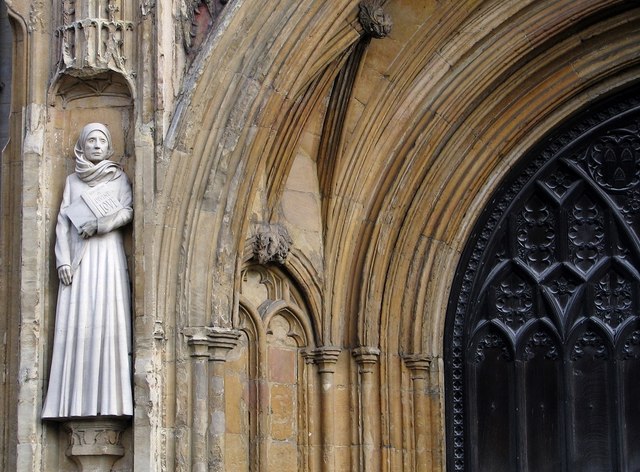
I don’t pray much anymore, in the traditional sense. But in times of trouble, there are certain recitations I return to. One I’ve been repeating lately comes from the Medieval anchoress and mystic Julian of Norwich: All shall be well, and all shall be well, and all manner of thing shall be well. The lines appear in her work Revelations of Divine Love, an account of the visions she experienced while gravely ill, around the age of 30. According to Julian, the words come from Jesus himself.
We don’t know a lot about Julian’s life but we do know she was an anchoress, a kind of hermit who lived walled into a tiny cell attached (anchored) to a church. And we know that the England of her day was full of turmoil and uncertainty. The Black Plague had ravaged Europe, taking an estimated 50 million lives. The church was suppressing religious minorities and reformers. The serf class, outraged against the draconian laws laid down by the ruling class, rose up under the leadership of early labor organizer Wat Tyler, in the so-called Peasants’ Revolt of 138, and was brutally put down by the aristocracy.

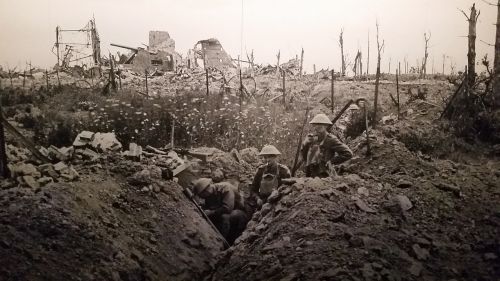
Years before I read Revelations of Divine Love, I encountered the line all shall be well in T. S. Eliot’s poem The Waste Land, penned in 1922 and heavy with allusions to literature, myth, and religious texts, including Julian’s. Eliot wrote his poem shortly after World War I. Europe was in disarray, the downtrodden poor were rising against their oppressors, and the Spanish flu epidemic had ravaged much of the world, infecting approximately one-third of the entire global population. Eliot wrote The Waste Land while still convalescing from the virus. Yet Jesus, as far as we know, did not visit Eliot. And while Revelations of Divine Love is suffused with warmth, the perspective in The Waste Land is grim, with only whispers of hope.
“All shall be well” is Jesus’ response to Julian’s distress over the sin and evil in the world. In her vision, Jesus assures her that sin is behovabil—behovely, necessary, needful, unavoidable. The idea strikes me as akin to the felix culpa idea. Translated as “happy fault” or “blessed fall,” the phrase appears in the Exultet, a 5th-century hymn that is sung as part of the Holy Saturday liturgy, but was already present in the writings of various church fathers, including St. Ambrose and St. Augustine, and in Christian scripture: “All things work together for good to them that love God” (Romans 8:28).
When I was a young adult in a hyper-conservative space that used God and the threat of damnation to intimidate people, I was drawn to the ancient Christian idea of felix culpa that assured me that the divine nature was more generous, creative, and expansive than the people who wielded religion against me would have me think. It assured me that God was bigger than my missteps and that my sins were not the final word. In that culture, “sin” was usually code for sex stuff. There was little discourse about the sins of the powerful who oppress the vulnerable, even though that’s what Jesus talks about, again and again.
Now, when I think about sin, I think of malice, injustice, violation, oppression of the vulnerable, deliberate harm, greed, indifference. Sex stuff can be a part of all that but it’s only a part. Basically, I have learned to think seriously about sin. So when I look at the weight of the suffering some inflict on others, the lives extinguished brutally, the people enduring vast horrors with little hope, and the suffering that extends beyond humanity into the animal kingdom, saying “God is bigger than this” doesn’t resonate as it used to. It feels flippant.
Nor do I buy the argument that this suffering is the price of free will. Or that suffering is redeemed and made blessed by Jesus’ death on the cross. Adding suffering to suffering is hardly a fix. If the idea is Jesus couldn’t have expressed the depth of divine love for us without dying to redeem us from sin, I’m afraid I’ll have to take the position of Fyodor Dostoevsky’s atheist character Ivan Karamazov, who says to God, “I respectfully return the ticket.”
I need to keep hoping that justice and healing are possible, even if I can’t comprehend what resolution might look like.
Rebecca Bratten Weiss
Yet Jesus’ assurance to Julian still gives me hope. Is it simply the psychological effect of repeating it as a mantra? Perhaps that’s part of it. But also, I need to keep hoping that justice and healing are possible, even if I can’t comprehend what resolution might look like. If I am going to keep being a small part of the ongoing project of bringing about justice, I need to believe that it’s possible. Because often, the best efforts seem to be in vain. Often, heroic people labor and sacrifice to defend goodness and oppose evil, and die without seeing the world grown gentler.
In Julian’s day, the peasants who revolted against their oppressors did not live to see a time when serfdom would be abolished. In Eliot’s day, the horror of one world war would soon be followed by another that would kill at least four times as many people, not counting the genocides. Today, the ideologies that motivated both the oppressive aristocrats and the European fascists have burgeoned again. It would be easy to accept that the answer to it all is nihilism.
In another of Julian’s visions Jesus shows her “a little thing, the quantity of an hazel-nut, in the palm of my hand; and it was as round as a ball.” When she asks him what it is, he tells her: “It is all that is made.” She marvels that such a tiny thing could survive. But, Jesus tells her, “It lasteth, and ever shall last for that God loveth it.” I’ve read that passage often. But only recently did I notice that the tiny hazelnut Jesus shows Julian is in the palm not of his hand, but of hers.

It reminds me of the words of another woman mystic, Teresa of Avila, who also saw violence and injustice in her life, and who wrote:
Christ has no body now on earth but yours,
No hands but yours, no feet but yours;
Yours are the eyes through which Christ’s compassion looks out on the world,
Yours are the feet with which He is to go about doing good,
Yours are the hands with which He is to bless us now.
What keeps me going is not the mystic promise on its own, but the mystic promise coupled with the witness of those whose hands do the work of justice and compassion in this world. The mantra all will be well is my belief in their work, that I must believe is also God’s work. And it connects me, across the waves of the years, with others who have beheld times as dismal and violent as these, and seen mostly a waste land, yet chosen to believe that suffering is not the last word.
For more by this author and more on hope, visit our website.
ABOUT THE AUTHOR

Rebecca Bratten Weiss is a writer and academic residing in rural Ohio. She is the digital editor for U.S. Catholic magazine and can be found at rebeccabrattenweiss.com.
You must be logged in to post a comment.