
Detachment and a relational economy
Our relationship with the stuff of our lives can be complicated.
Look around the space where you are sitting. Whether it is an office or public space or bedroom, what fills the room? Where is it all made? Who made it? What are the stories that come with the stuff of your space?
Depending on where you are, the answer to these questions can vary greatly. In one room of my home, I may point to the coffee table my wife and I made out of reused cedar that holds the memory of shared work in our early marriage – a memory sprinkled with glad collaboration, some disagreements around wood glue vs. screws, and the mishap of the recurringly wobbly front right leg. Looking at that piece of furniture brings me a lot of joy. In that same room I can point to a wooden chest made by my grandpa decades ago, some just-the-right-feel mugs in the corner handmade by our potter friend, local and handmade beeswax candles from a flower farmer, and a piece of art painted by my wife. All of these items furnish our home and enliven our home-making, as they hold relational stories and are pathways of deep connection.

I move down the hallway in our home and come across a motorized vacuum cleaner laden with plastic, acquired on Amazon, made by we-don’t-know-who probably from somewhere across the ocean. Beside that is a drawer of chemical-ized cleaners and detergents from Costco, a slew of cheaply made and underappreciated synthetic toys, and a couch we got from a stranger on Facebook marketplace with a history unknown to us. The sources and makers of all of these items hold no particular relational story or connection for our family.
It’s a real mix in our life. A threadbare, hand-me-down hoodie gets replaced with a treasured hand-sewn hoodie that gets lost and in short order replaced with another from Target. Our family is committed to the pathway of slow, patient work that reduces the gap between consumer and producer, pressing into the gifts and vocations of our local community to furnish our life. And yet, we also live in a world with a million choices and the weight of layers of discernment that include things like cost, convenience, relationship, labor and laborer, and time, among other things. It’s messy.
What guides my consumptive choices? Who produces our furniture, our clothes, our tools? Who grows and cares for our food? Why does it matter (or not) to me? How can my household engagement with consumption and production announce a more relational economy, a more integral human ecology?
As I ask these questions, it seems worth investigating some of the layers of “detachment.” In our quest for an economics worthy of the human person, it will be helpful to explore two different types of detachment. A detached economy, one that separates producers from consumers and breeds abstraction, lies at the root of our throwaway culture. Contemplative detachment, on the other hand, recognizes our ‘end’ as God and forms us in freedom to love.
“Our problems stem from our acceptance of this filthy, rotten system.”
~ Dorothy Day
The virtue of detachment in the second meaning is at the heart of the Christian contemplative tradition. As we deepen in love of God and love of neighbor, it is necessary to resist being dominated by the power and caprice of our own will and preferences. Detachment is connected to freedom, while attachments make for an easy confusion between means and ends. Detachment helps build habits supportive of love.
“Detachment from things does not mean setting up a contradiction between ‘things’ and ‘God’ as if God were another thing and as if creatures were His rivals. We do not detach ourselves from things in order to attach ourselves to God, but rather we become detached from ourselves in order to see and use all things in and for God.” –Thomas Merton
Detachment is at the center of a life that is free to love things for what they are, people for who they are, God for who God is. Our attachments and clingings have a way of dulling our inner longing for God. This involves our relationship with money, possessions, and the natural world, as well as our attitudes, feelings, and will.
And yet ‘detachment’ in the first meaning dominates much of our financial structures and imaginations. We are dislocated from our goods and the producers of those goods. This dislocation makes us susceptible to a lack of respect and attentiveness for not only the material stuff of our lives, but also for the dignity of the laborers and labor involved throughout the process. While holding the centrality of the contemplative vision of detachment, I wonder how we might move toward disrupting the disordered processes of detachment that bolster our economic systems based on abstraction and materialism? Perhaps this ‘detachment’ is closer to a form of alienation. Tending to this dynamic of alienation and detachment can foster a re-humanization of consumption and production in such a way that nurtures our souls and our common home the Earth, while creating a more just social and economic order.

“The concept of alienation needs to be led back to the Christian vision of reality, by recognizing in alienation a reversal of means and ends. When man does not recognize in himself and in others the value and grandeur of the human person, he effectively deprives himself of the possibility of benefitting from his humanity and of entering into that relationship of solidarity and communion with others for which God created him. Indeed, it is through the free gift of self that man truly finds himself… A man is alienated if he refuses to transcend himself and to live the experience of self-giving and of the formation of an authentic human community oriented towards his final destiny, which is God. A society is alienated if its forms of social organization, production and consumption make it more difficult to offer this gift of self and to establish this solidarity between people.” – Pope John Paul II in ‘Centesimus Annus’
Our little community started to explore our own layers of ‘detachment’ and how our common habits lead to freedom to love and how they are connected to extraction and throwaway culture. One practice that emerged from this exploration years ago was a regular gathering we called “make-shares” – well, they were regular until they weren’t…we are still wading through the waters of inconsistency. They are simply spaces for making and sharing in a world that pressures us to endlessly consume commodities and to keep them to ourselves. One of our Saturdays we sewed cloth napkins. Each of our four seamstresses in the community brought their sewing machine and the couple dozen people who came got to participate in the process as they desired. Everyone left with a bundle of napkins. We’ve also experimented with homemade detergents, soaps, beeswax candles, and canning. These gatherings are small denouncements of a detached economy and invitations to participate in an economy worthy of the human person.

The division and de-humanization that is so prevalent today is fueled by structures of a detached economy. God give us ears to hear the cries of the poor, including the earth as our common home. How can the Church foster small enclaves of shared life infused with the virtue of detachment, oriented toward human-centered economic lives of encounter and solidarity? How might we cultivate communities that hold us accountable to ways we truly want to live – following Peter Maurin’s charge to create a society where it is easier to be good?
As we approach the Advent and Christmas seasons, may our resistance to the mechanisms of alienation in our gift-purchasing (or gift-making) be an announcement that Jesus is here. Jesus, the Incarnate One, who inaugurates a peaceable kingdom of communion and self-giving.
For more by this author and more about detachment, visit our web site.
ABOUT THE AUTHOR
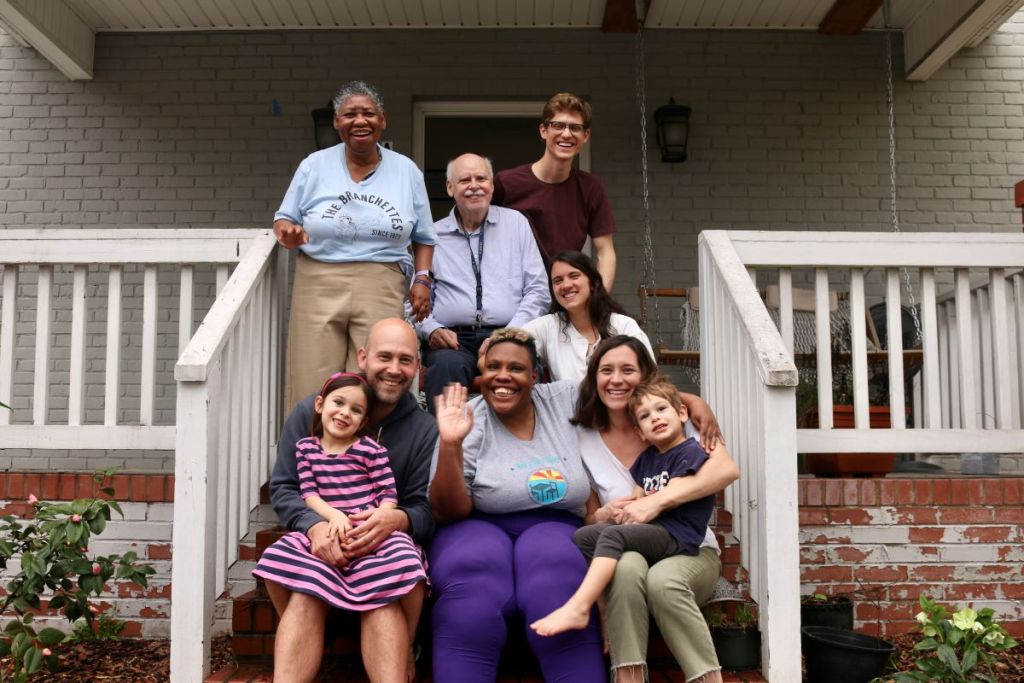
Greg Little is a husband to Janice and father to JoyAna and Elias and Terese (Resa), and he has a home at Corner House in Durham, North Carolina. He has learned from various schools, including several Christian communities seeking justice and peace (a Catholic Worker home inspired by St. Francis, Durham’s Friendship House and Haiti’s Wings of Hope) and is committed to a life ordered by daily communal prayer and littleness. He works at Reality Ministries, a place proclaiming that we all belong to God in Jesus through fostering friendship among people with and without developmental disabilities. Greg and Sister Julia recently met in the wonder of interfaith dialogue about monasticism and the contemplative life at Mepkin Abbey in Moncks Corner, South Carolina.