

When You Don’t Want to Look Back (and the Examen that meets you there)
I wake up at 4:20 a.m. Unable to get back to sleep, I brush my teeth, make a cup of coffee, and curl up in a rocking chair in the living room. My cat sits nearby. Christmas tree lights illuminate the dark room with a warm glow.
The day before, I attended my kids’ Christmas program at school. One of the classes sang “Ven a Cantar,” a Latin American Christmas carol that I learned while living in Peru as a missionary more than a decade ago.
It’s a song filled with hope and nostalgia, opening with a verse that pulls on your heartstrings as you realize the year is winding down:
Otro año que queda atrás
(Another year left behind)
Mil momentos que recordar
(A thousand moments to remember)
Otro año y mil sueños más
(Another year and a thousand more dreams)
Hechos realidad
(That have become reality)

I think of this song now in the quiet dark of the early morning. It’s the perfect opportunity to look back on the year that is coming to an end – an exercise I’ve been avoiding. When I try to take stock of the past year, a knot forms in the pit of my stomach. I’m not feeling nostalgic or hopeful, but resistant. 2025 was a difficult year, and its challenges aren’t ending. So much of humanity, including the community I am immersed in, is still crying out for reprieve.
But it’s not just that. Despite some achievements to be proud of, what stands out are the areas lacking progress. I don’t want to recall all the ways I failed this year, all the ways I continued to struggle with the same flaws that have been haunting me year after year. I feel ashamed.
There’s a familiar tool that is supposed to help us with these moments – the Ignatian Examen. Despite knowing about this tool for many years, I’ve struggled to incorporate it into my daily life. Feelings of shame are nothing new for me. They often accompany the end of a day, especially when my throat is hoarse from yelling too much. Sometimes I bring the feelings to prayer, but more often than not I distract myself until falling asleep.
My cat gently bats my face, and I scratch behind his ears. I unlock my phone to look into what Ignatian spirituality might want to tell me about shame.

St. Ignatius directly addresses shame in the First Week of the Spiritual Exercises, differentiating two kinds of shame. One is a feeling of being unworthy, unloved, or not good enough, while the other is the realization that I have done something wrong.
The latter is the “healthy” sense of shame, but I’ll let you in on a secret you probably already know: they both feel terrible. Yet I can’t expect to heal by refusing to look at what is hurting me.
The Examen guides me to look back gently, with compassion, and without judgment. I appreciate how Loyola Press describes it in their “Ignatian Prayer Adventure”:
We don’t get very far just by counting our sins and trying to overcome them by sheer force of will. Instead, we need to keep our eyes fixed on God’s ever-present mercy, which is the ultimate source of our lasting liberation from sin.
So I try. I look back, trying to keep my eyes fixed on mercy.
I see a lot of anger. I see myself losing my patience. I see scenes where my kids push back, calling me names that seem to match their own feelings of anger or injustice. This triggers something in me from my own childhood, and I recall how my older brother and I would fight, and the feelings of unhealthy shame that came from that.
But I’ve worked through that already — I do know now that I am good, and loved, and I know my kids are, too. I know their actions of pushing back are a symptom of their emotions, their lack of control, their needs that are unmet in the moment.
Something in me softens. I suppose that’s all true for me, too.
Thirsty. Hungry. Tired. Overstimulated. Juggling too much. Worried. Sad. Overwhelmed by the news. Trying to multitask instead of being present. Focused on my own goals.
At this point in my quiet morning reflection, I let my mind wander. My cat bites pine needles off the Christmas tree, and I watch him for a few moments.
I come back to the reflection. I recall, not specific examples, but feelings I’ve had this year after saying something tone-deaf or publishing something that made me feel exposed and vulnerable. The knot in my stomach forms again.
I close my eyes and let it all sit. I imagine this cloud of God’s presence kind of soaking the feeling. I stay there for a moment, then open my eyes.
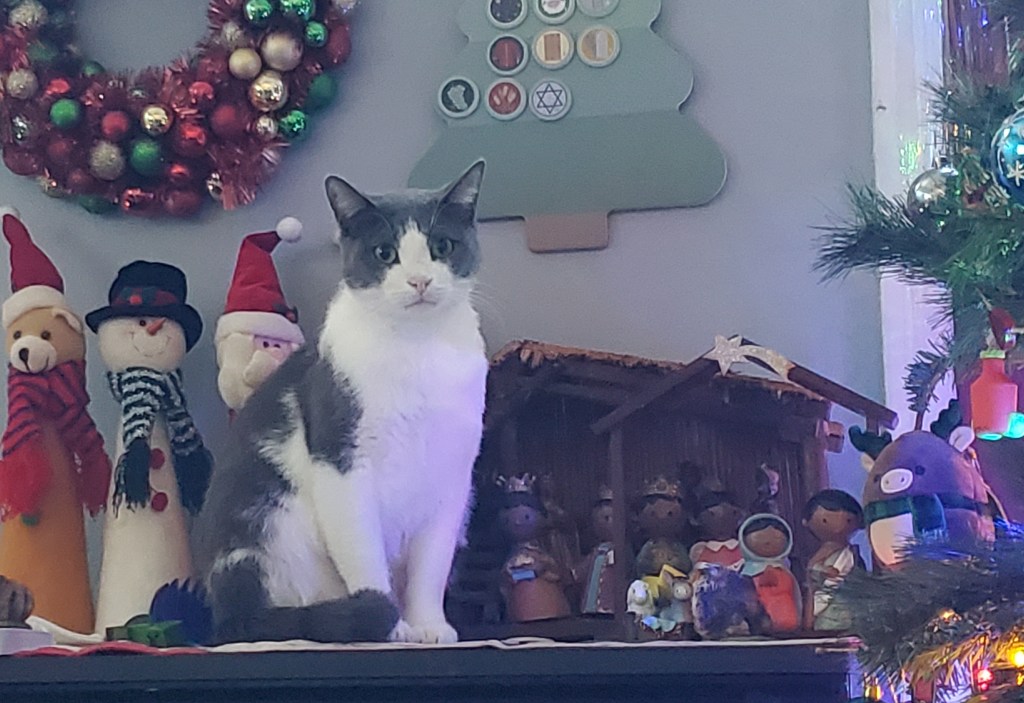
Now my cat is crouching and pouncing on something invisible to the human eye. The tension in my body eases, and with it the urge to keep reflecting. As I let go of my examen for now, I continue gazing on the tree. I don’t know if the Examen will find its way into my daily rhythm in 2026, but I am encouraged by the shift in my feelings after a few ordinary moments of gentle meandering in my mind.
Perhaps this act of looking back isn’t just an affirmation for perfect years, but a practice for broken ones.
I uncurl my legs and get up to eat some breakfast — feeling a little bit lighter, a bit more healed, a bit more ready to face what’s ahead, a bit more ready to hold on to the thousand moments behind me.
For more by this author and more about the Examen, visit our web site.
ABOUT THE AUTHOR

Emily Cortina is a mother raising three bilingual, bicultural children alongside her Mexican husband. Based in Chicago, Illinois, she advocates for restorative justice and accompaniment of individuals impacted by incarceration in her local community and through her work with Catholic Prison Ministries Coalition.


