

The Good News
Based on Luke 4
I never have good news for Jesus. I deal in the gloom and doom. But that doesn’t make me any less welcome in his home.
I lower my head as I meet his mother at the threshold, then allow myself a half grin as her arms wrap around me. I am no stranger there, nor is anyone else. His mother said that she, Jesus, and his father had been totally dependent on the kindness of strangers during their time in Egypt, where she learned a deeper meaning of hospitality. Jesus and his mother are always hosting people from far away places, people with drawn faces and weary eyes and few belongings. I still don’t know how they find the place. Countless times I’ve listened to those wayfarers’ songs, their stories, told late nights while Jesus, like his father before him, sands the pieces that will one day furnish their new homes.
The home is full of cooking smells. “It’s true, then? He’s back?” She nods. “What’s left of him. So thin,” she wrinkles her nose, and turns to stir a pot. He had been vague when I saw him a few weeks earlier, something about a silent retreat in the wilderness. We were afraid he would end up like cousin John.
I find him outside, squatting down near the ground, writing in the sand with a stick. Since we were kids, he’d do this when he didn’t know what to say or do and didn’t want anyone to know. But now no one is around, except me, which concerns me.
As if sensing my feelings, he spins around with the biggest smile, opening his arms wide in greeting, “What’s the good word?” he beams. I almost fall for his reassuring demeanor. But not quite. “Oh, I dunno. We’re still under Roman occupation. Herod’s a puppet. People are hungry. Taxes are up. Life expectancy is down. I can’t find decent work outside the house. My bread didn’t rise again this morning.”

“Blessed be the Name of the Lord!” he shouts. I try to remain annoyed. Jesus does not have the sympathy of a psalmist. “I’m going to read at synagogue this week,” he continues, “and I was thinking of this passage.” He reads from his scratchings in the ground.
“Sure, if you want people to come after you with sticks and stones! Jesus, you can be so insensitive. Not everyone can live on desert air like you. They will think you are taunting them.”
Something in his eyes changes. Maybe I was taunting. Maybe I’ve hurt him. Or is it fear? I touch his hand.
“Will you be there?” he asks.
“Of course,” I promise.
On the Sabbath, I inhale deeply as he unrolls the scroll from Isaiah and projects:
‘The Spirit of the Lord is upon me,
because he has anointed me
to bring good news to the poor.
He has sent me to proclaim release to the captives
and recovery of sight to the blind,
to let the oppressed go free,
to proclaim the year of the Lord’s favour.’
To my surprise, he stops there, and sits down, and speaks into the silence, “Today this scripture has been fulfilled in your hearing.”
My heart races like a mouse in a cat’s mouth as the verbal sparring begins.
Who do you think you are?
Well, do it then! We have the blind and the lame right here.
Go to the prison! Go to the governor! Go to the EMPEROR!
Blasphemy!
Lock him up! Lock him up! They begin to chant.
People are standing up; the dust is rising. Everything starts to swim before my eyes. This is not the time to faint, I tell myself, as things begin to go black.
Or did Jesus say that? I can see only him now. I can hear only him and the whoosh of blood pumping in my ears.
“It is not about me. It is about us all. WE will deliver the captive — in body, in mind, in spirit. Together. That is the good news. We are the good news.” He walks toward me, as if no one else is there at all. “You are the good news.”
I open my eyes to the faint January light, my dreams crumbling like words printed on old yellowed paper. I reach for my phone to read the news. So many people are afraid.
I swipe to my calendar, read the names of the people I will talk with today, and hold their anxieties, sadness, rage, for a moment, searching for what news I might give them, to satisfy the weary with a word. Then a thought comes from I-don’t-know-where. “That’s not my job, to give them good news,” I murmur.
I can only give them myself. I can only say that they and me and you and we are
The Good News, the Gospel of our Lord Jesus Christ.
For a creative take on the annunciation, see the post here.
ABOUT THE AUTHOR
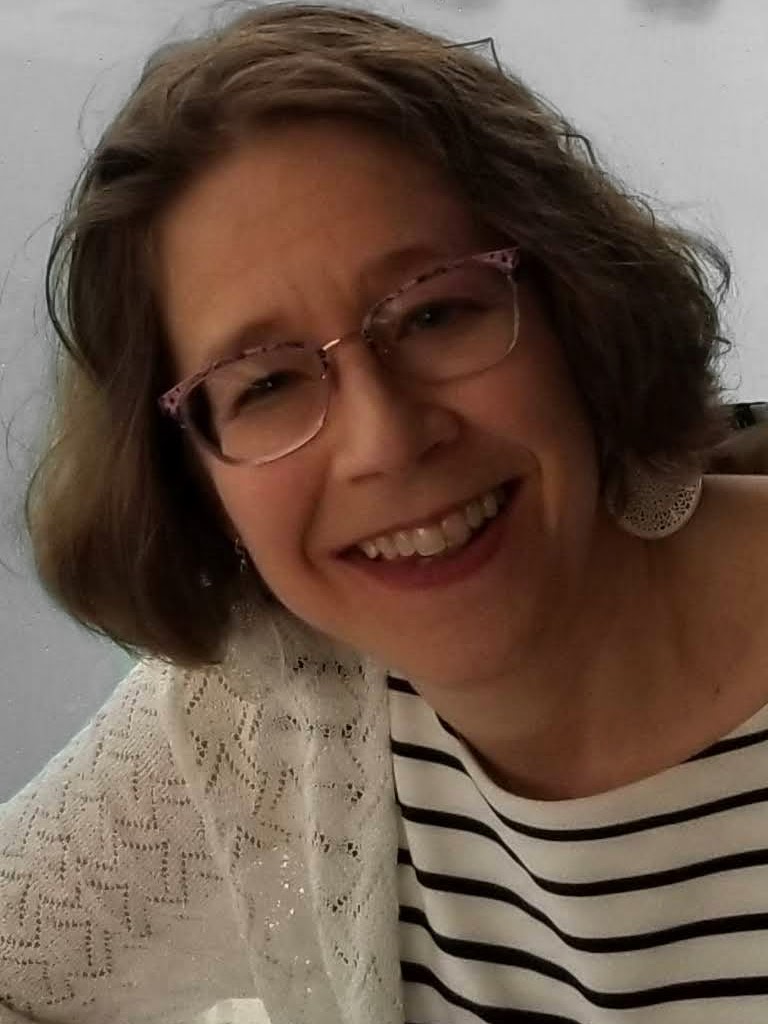
Angela Paviglianiti was ruined for life in the Jesuit Volunteer Corps around the turn of the century. She is what happens when you mix women’s studies, social work, and seminary. Angela is indebted to Ignatius of Loyola and Dorothy Day, although she probably wouldn’t have gotten along with either of them. She still believes in fairies, and the Gospel according to you and me and us.


