
In Praise of Disenchantment
My region is experiencing severe drought. The grass is pale and crispy, streams are low, the corn looks stunted. Farmers still haven’t gotten their second cutting of hay in, and I worry about what the future holds. This is part of a broader pattern of weather fluctuation that matches the climate assessment for my state. We can expect to see more periods of intense dryness alternating with wet, muddy seasons that make it difficult to feed livestock or harvest crops.
Will this be the wake-up call that alerts my community to the realities of climate change?
I’m not too hopeful. The little communities near me have deteriorated over the past decades. Despite the efforts of local councils to access federal funding for infrastructure and community improvement, buildings are falling into disrepair. Absentee owners leave houses untenanted, with heaps of junk in the yards. Local businesses keep closing, while dollar stores move in. Young people move away, looking for better jobs. The coal industry already did a number on us, now climate change is adding to the dereliction. Yet people continue to vote against their own interests.
Years from now, will we look back and realize we should have listened to the climate scientists?

I thought of this while praying with a Scripture passage wherein Jesus rebukes the religious leaders of his day:
“Woe to you, scribes and Pharisees, you hypocrites.
You are like whitewashed tombs, which appear beautiful on the outside,
but inside are full of dead men’s bones and every kind of filth.
Even so, on the outside you appear righteous,
but inside you are filled with hypocrisy and evildoing.
“Woe to you, scribes and Pharisees, you hypocrites.
You build the tombs of the prophets
and adorn the memorials of the righteous,
and you say, ‘If we had lived in the days of our ancestors,
we would not have joined them in shedding the prophets’ blood.’
Thus you bear witness against yourselves
that you are the children of those who murdered the prophets;
now fill up what your ancestors measured out!”
(Matthew 23:27 – 32)
Usually, reading this passage, I focus on the “whitewashed tombs.” I can hardly remember what it felt like, to look up to my own religious leaders as moral heroes. But I can definitely remember how shattering it was, the first time I learned that someone I respected had a pattern of unethical behavior, the first time I learned that a priest I’d thought well of was guilty of horrific abuse. I remember how taken aback I was, eight years ago, when people I knew who preached the importance of moral character lent their support to a political movement founded on resentment, fear, and ignorance.
Now, I’m beyond being shocked. I guess you could say I’ve grown disenchanted.
Reading the “woe to you” passage this time around, I was struck by the second section. Jesus is essentially telling the hypocritical leaders “you claim that you would have been on the side of the good, back in the day. But you are in the camp of those who opposed justice and murdered God’s prophets.”
We all like to believe that we would have been on the right side of history. We would all have been abolitionists, all resisted the Nazis. Of course, even thinking this way implies a level of privilege. For those in demographics that were targeted by the slavers or the Nazis, neutrality was never an option. Still, regardless of our privilege, we are all positioned to choose how we respond to the moral challenges of our time.
And this is important, because moral improvement is not inevitable. The arc of the moral universe doesn’t automatically bend toward justice. Left to its own devices, history produced the horrors of colonialism, chattel slavery, and mass genocide. Progressivism doesn’t work without an orientation toward an objective good. But to discern that good, we may need to ask hard questions, force ourselves to think both empathetically and critically, and step out of the comfortable mental grooves. It’s easy to cheer on our heroes once they are safely dead. While they are alive and making us uneasy, we’re more likely to turn away from “all that divisiveness.”
Why does “disenchantment” carry negative connotations? It literally means being freed from a spell. In fairy tales, being disenchanted means reclaiming yourself, or escaping a malign force. Recently, I reread C. S. Lewis’ The Silver Chair. When they descend into the underworld, and meet the Earthmen who are enchanted by the Green Witch, they all recite the same mantra: “Many fall down, and few return to the sunlit lands.”

In other stories involving spells, hypnosis, or brainwashing, there is often this motif of sameness, falling into a rhythm. In Madeleine L’Engle’s A Wrinkle in Time, the people on the totalitarian planet of Camazotz all act in unison, even in something as basic as bouncing a ball. In The Waste Land, T. S. Eliot depicts the souls of the damned going round and round in circles.
Christians, especially Catholic Christians, love rituals and traditions. Ritual allows us to step outside linear time and recapture cyclical time, continuity and connection. Tradition tells us who we are, where we have been. I value tradition, as an ethnically Jewish woman, because it is a reminder of what my ancestors endured, and how they stood together in the face of existential threats. But rituals and traditions can become idols, too, and in worshiping them, we fall into the bad kind of enchantment, losing our identity, our moral center. We repeat what we are told to believe. We do what we have always done. We gather in the town square for a procession, for a ritual, for a dance, for a stoning. Seventy years ago, tradition would have told us to oppose Civil Rights. Today, tradition tells us to oppose LGBTQ+ rights. Are we willing to really think, or are we just going to repeat what we are told?
I think it’s useful to practice disenchanting ourselves, stepping outside the cycles of rituals and traditions. We can convince ourselves that the world is not changing, the seasons are the same as ever. But this summer is not like summers that came before. And the summers to come may be hotter, drier, more catastrophic.
If we are going to rise above the status of white-washed sepulcher, we need to be disenchanted. Rituals, recitations, and traditions are good up to a point, but if we let them dominate us, we become like the Earthmen in The Silver Chair, mindlessly repeating what we were told.
If we are not thinking for ourselves, we become like the religious leaders Jesus denounced, religious leaders who are good at reciting prayers but turn against prophets.
Today, on the path beside the creek, the yellow leaves were already falling. They will all fall early this year. I expect the sight of them falling, drifting in the thin and sluggish stream, will be enchanting.
ABOUT THE AUTHOR
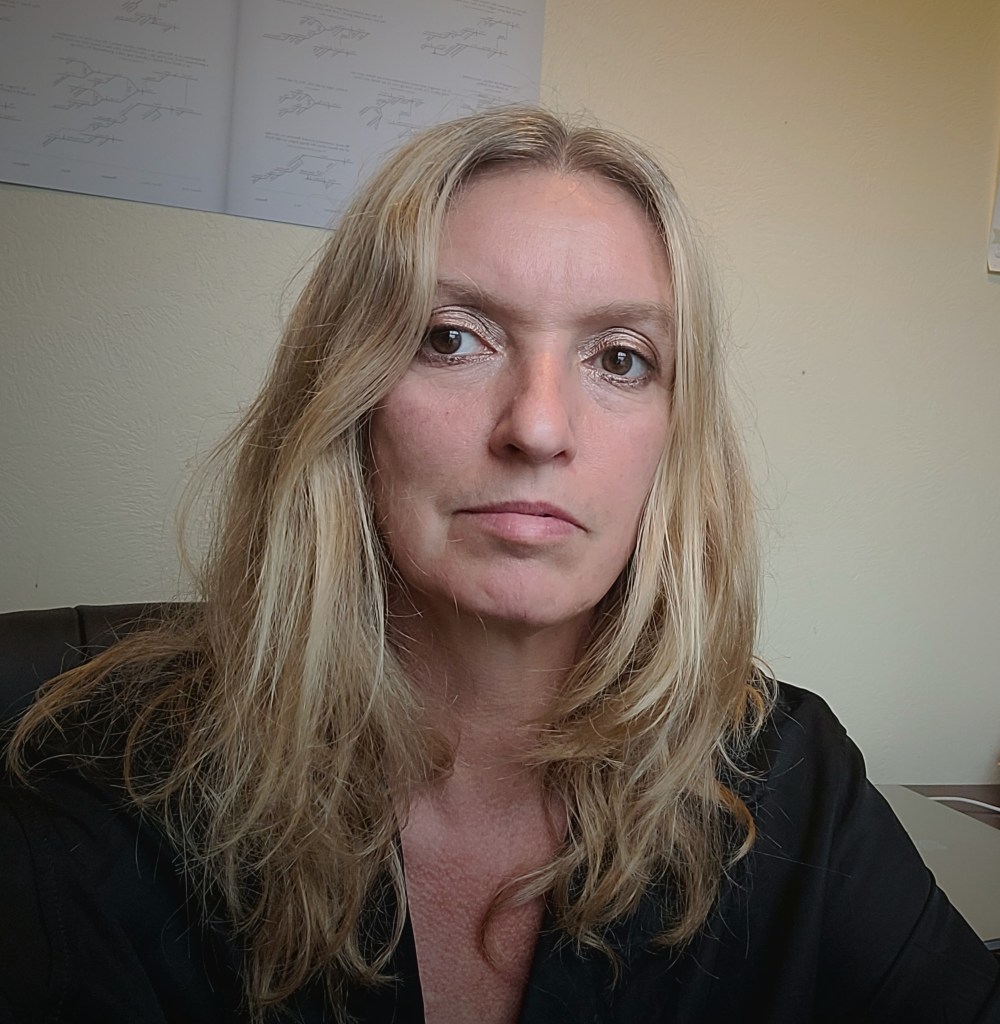
Rebecca Bratten Weiss is a writer and academic residing in rural Ohio. She is the digital editor for U.S. Catholic magazine and can be found at rebeccabrattenweiss.com.