

Christmas at Greccio: The Incarnation through the Eyes of Saint Francis
Let’s set the scene, briefly. This took place toward the end of his life, when Francis of Assisi had already visited Bethlehem in the Holy Land, and had seen the Sultan in the Nile Delta; he had already witnessed his religious order “moving on” past his initial inspiration and leadership (in ways that sometimes saddened him).
He’d visited Rome in late November 1223, because Pope Honorius III (the Holy Father whom we usually neglect when telling the life of Saint Francis—he reigned between Innocent III and Gregory IX) was prepared to give papal approval for the updated Franciscan Rule. This is the Rule of 1223 that still governs the friars today.
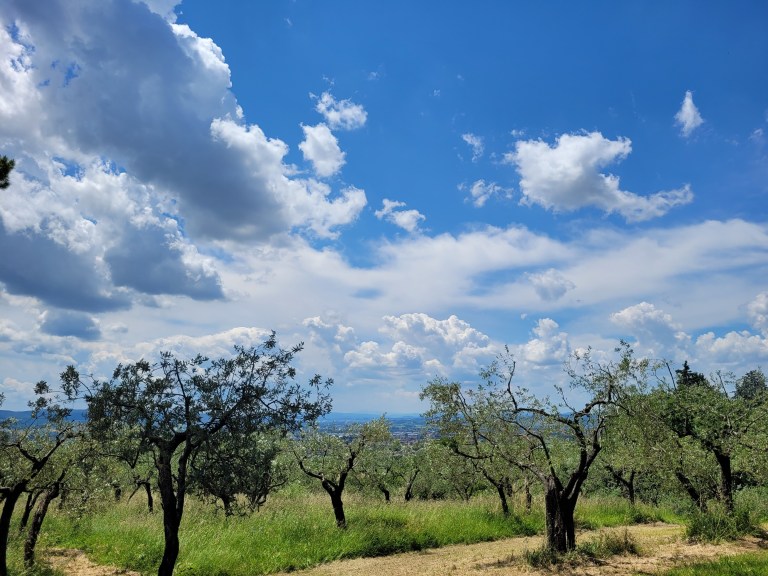
What we are here today to talk about is what happened on Francis’ way back from that trip to Rome (to which he was never to return), in December of 1223, stopping in the valley outside Rieti, at a village called Greccio. This is 90 kilometers directly south of Assisi, and similar to Assisi in that it was a hill-town of ancient origins with forests and mountains all around. Greccio is not usually on the pilgrim’s or tourist’s path today, but it is an important place in Franciscan history and life.
There in Greccio Francis organizes a Midnight Mass, intending to make it a special moment, unlike a Midnight Mass anyone had experienced before. He asks a man named Giovanni, or John, for help with this project. Francis asks Giovanni—who had left behind a soldiering career in order to become a Franciscan—to help him construct and organize a Nativity creche. Giovanni likely still owned the land upon which this special Nativity was to be celebrated.
On a hill, with woods behind it and valley below it, the scene would be recreated. There, a stable was built, outfitted with a rough feeding trough, hay, animals (an ox and an ass), and eventually then a young husband and wife, and the people of the town bearing witness to it all, holding torches and candles in the night. So it happened, that in Greccio, for the first time in history a live Nativity scene was created, populated, with human beings and animals, as a liturgical event. What we know as the creche had its origins in that evening in Greccio 800 years ago.
What were Francis’s motivations? “In that moving scene shines forth the simplicity of the Gospel: poverty is praised and humility presented to us in a positive way,” he said. Also, Francis said, “I wish to enact the memory of the Babe who was born in Bethlehem: to see as much as possible with my own eyes the discomfort of his infant needs.” It is likely that Francis intended his live Nativity to be a devotional replacement for what was then most often a pilgrimage combined with the crusading movement, to visit Bethlehem in Palestine. He seems to have intended for Christians to find Bethlehem—in all that it truly means—in their own lives here and now. Like when Jesus taught his disciples not to be showy in their praying, but to go into a closet, or another room, to pray in secret; first century houses in Palestine were tiny, shared spaces; they didn’t have multiple rooms! That “other room” is where you go inside yourself, to meet God who is there waiting.
Francis wanted us to see and know God in a new way. We are both seeing and being seen by God in the manger. What do we see, there? Who sees us, and what does he look like?
Greccio was the site of one of those iconic moments in the life of Saint Francis. It was miraculous without being spectacular. It was one of what we might call Francis’ “soft” miracles of ordinary life and joy. Greccio was, before this happened, a place familiar to the friars. But after this special Christmas Eve, it became a treasured place of sanctuary, retreat, and contemplation. It is for instance Greccio that Blessed John of Parma chose for his mandatory retreat of silence after being criticized for overseeing a chaotic time in the Order after Francis’s death.
The poverty of the first Nativity was central to Francis’ vision. Summarizing Francis’ sentiments, Bonaventure wrote “Christ was poor at this birth, poor during the course of his life, and poor at his death.” This poverty was so very important to Francis, and it was made real in what he caused to be created in Greccio. We think most often of Francis imitating Christ, ultimately, in the inexplicable event of the stigmata—but we forget how often and insistently he set out to imitate him in the manger. Let me explain.
One early collection of stories about Francis, called The Assisi Compilation, records an anecdote that took place soon after the scene in Greccio. It was again Christmastime, perhaps the following year. The narrator tells us: “It happened that the brothers of that place on Christmas day itself prepared the table elaborately because of a visiting minister, covering it with lovely white tablecloths which they obtained for the occasion, and vessels of glass for drinking.” When Francis arrives to eat the meal, and sees the table set so finely, he quietly leaves and dons the “the hat of a poor man,” it says, and carries a staff down to the road, where he begins to beg for his bread, as a friar is supposed to do. A little while later he knocks on the door, like a pilgrim might do, and shows the friars who answer it what he has to eat. He was, of course, making a point. Taking on flesh, in such poor circumstances, the holy Child from his first hour had nothing, was identified with the poorest of the poor.
Francis found many ways to identify with the Christ of the manger. I know this may seem odd to us, today—to hold up as exemplary what I am about to hold up—but just consider for a moment: Those iconic occasions when Francis stripped himself naked, was happy to be naked as he was the moment he was born. There was the time when his religious life began, in front of all the people of Assisi, in the bishop’s piazza, his father confronting him, demanding an apology for insolence, and Francis responds how? By removing his father’s clothes, laying them at his dad’s feet, and saying, “My only father now is in heaven.”
There was also the occasion a couple years later when he was too severe in ordering a friar-friend to go and preach in town, and so Francis finds him and begins to preach himself, but removing all his clothes, to do so in total humility. And at the end of his life, wanting to die in the way he was born, he removed his clothes to feel the dirt of the ground on his skin.
Remember that Jesus was stripped naked on the cross. He was also born naked—as were we. And the swaddling clothes of the Gospel account were viewed by Francis as a bookend to the tiny strip of clothing that Christ had on, the night of his humiliating death. So you can see why nakedness was somehow religious to Francis, and how Jesus in the manger was poor and suffering and naked, not cute and chubby and sentimental, as we tend to make him, or see him, in our creches today. Francis wants you to see the poverty of the Child, who came to be mixed up with the poverty of others, in that manger.
Clare of Assisi, in the Rule she wrote for herself and her Sisters, said: “Out of love of the most holy and beloved Child wrapped in poor swaddling clothes and placed in a manger and of his most holy mother, I admonish, beg, and encourage my sisters to wear poor garments.” To wear rough-hewn clothes, then as now, was to live counter-culturally, and for Francis and Clare it was to do so in imitation of the king born in a stable.
In Clare’s first letter to Agnes (a Bohemian princess who’d become a Poor Clare nun), Clare held up nakedness, just as Francis had done, saying to Agnes “One clothed cannot fight another naked, because she who has something to be caught hold of is more easily thrown to the ground.” In other words, one can only fight evil when one is stripped of all attachments and comforts.
A word about the ass and the ox. I want you to catch how special it was—and remains—that Francis raised up an ass and an ox as central to the story of the Nativity. We have trouble seeing this today, because we are so accustomed to what Francis created in what then became our ubiquitous creche scene. Of course, there’s an ass and an ox. I enjoyed, as a child, putting those figurines in place in the box with hay. And since those animals aren’t so easy to costume and act, our schools sometimes replace them with other, more far-fetched alternatives. There are the Nativity kangaroos in Australia, Nativity panda bears in China, and according to one of my favorite Christmas season movies, the Nativity play lobster in England. But—this is my point—preachers and theologians took little notice of the ass and the ox, of those sorts of earthy details at all, before St. Francis.
Saint Augustine, for instance, preached sermons on the feast of the Nativity, and on the birth of Our Lord, and never mentioned an ass or an ox. Why would he? They don’t appear in the Gospel reading. Why would they be anything other than incidental details? The thirteen sermons we have from Augustine, preached upon the occasion of this feast over the years, were very eloquently about the Virgin, about the Child, about God entering the world, the simplicity of the manger in contrast to the king who wanted to kill him and the kings from the East who came to pay respect to him.
I love Augustine’s sermons. They are beautiful. This is a paragraph that begins one of them:
That day is called the birthday of the Lord on which the Wisdom of God manifested himself as a speechless child and the Word of God wordlessly uttered the sound of a human voice. His divinity, although hidden, was revealed by heavenly witness to the magi and was announced to the shepherds by angelic voices. With yearly ceremony, therefore, we celebrate this day which saw the fulfillment of the prophecy: “Truth is sprung out of the earth: and justice hath looked down from heaven.” (Ps. 84:12)
Augustine—like most preachers today—wants to celebrate the coming of our salvation and redemption. The Nativity tells that BIG STORY. There’s nothing about the animals who were there that day. Those insignificant animals.
In fact, it’s from apocryphal sources that Francis got the ox and the ass. The animals are not identified in the Gospel of Luke, to which we usually turn for the Nativity, but they are offered in the Gospel of Pseudo-Matthew, which experts seem to agree was composed in the seventh century from much earlier sources and widely accepted as filling in the missing details regarding Jesus’ first twelve years. Those storytellers—they were composing Midrash, really—seem to have been inspired to try and make sense out of a line from the prophet Isaiah 1:3 that says, “The ox knows its owner, and the ass its master’s trough.”
The animals are also there in Giotto’s fresco on the wall of the upper church in the San Francesco Basilica in Assisi, where the most memorable scenes from Francis’s life were immortalized in the decades after his death.
I think Francis loved the animal details. There are many symbolic interpretations of the meaning of the ox and ass at the manger scene. Two of my favorites, that seem to speak to the interests of Saint Francis, are that these working animals beside the Child would have breathed on him, keeping him warm that first night. Notice how, in many of our creches, the ox and ass are positioned immediately above the Christ child, their noses and mouths almost touching his body. In that fresco in Assisi–#13 of 28 on the wall of the Upper Church—they are snug, up close, like special guests. Also, the animals would have been there to feed in the trough that the manger was, and as such they stand in creaturely for us, viscerally demonstrating the passage in St. John’s Gospel which says Christ is the bread of life and offers eternal life to those who feed on him.
There were of course many other animals in Francis’s life. I think of the Wolf of Gubbio, another animal essential to his story. After Francis brokered a deal between the people of Gubbio and this hungry creature, the wolf became tame, as he was cared for by the people of the village, and artists since then have often depicted Brother Wolf with a halo circling his head. The wolf—a creature like the ox and the ass—became a saint.
This was an innovation of Francis as well. The animal world was, until Francis’s time, most often considered mysterious, at best, or sinister, at worst. Human beings who suffered from mental illness were thought to be animal-like; to be declared mad (which was quickly assumed if you stepped outside the norms of society) meant that you were more animal than human. He has become a beast! people would say. Even after Saint Francis, with the Enlightenment, and then in the mannered ways of Victorian culture, these attitudes remained. They did not have the understanding then, that we do now, of human beings as human-animals, of our kinship and essential connections with non-human animals.
And there were many others. Sheep and lambs he often rescued from certain death, begging their handlers, who were carrying them to market, to give them to him. “Why do you harm my brother?” he pleaded at least once with a local man. In fact, when he assisted as a deacon at that first Greccio Nativity Mass, chanting the Gospel reading, we are told he had trouble uttering the word “Bethlehem” without sounding like a bleating lamb, his voice was so full of emotion.
Consider also the birds. This is of course the saint who preached to birds. It happened for the first time in the Valley of Spoleto as he was walking along, probably discouraged because very few of his fellow human-animals had much interest in his “preaching.” It was then that he noticed a lot of birds gathered along the roadside in the trees. I find it interesting, first of all, that he noticed this. Next, the text (from Thomas of Celano) tells us three of the species of these birds. They weren’t simply birds; they were doves, crows, and magpies.
It also says that, as Francis rushed to meet them, he greeted them “in his usual way.” This means that he said to them, “May the Lord give you peace”—a greeting that became a trademark for Francis, and that shows how the saint regarded these creatures as having similarities with his human siblings. The story of this preaching to the birds then concludes with the statement that “From that day on, he carefully exhorted all birds, all animals, all reptiles, and also insensible creatures, to praise and love the Creator.”[1]
Meanwhile, this is the same man who cared for bees in wintertime, setting out honey and wine for them. For whom, one of his first dramatic acts—and his life was full of dramatic acts—was purchasing a pair of doves in the marketplace only to then toss them into the air, setting them free. Francis would ask his brothers, if they had to cut down a tree, not to cut the whole tree, but to simply remove branches, so that the trunk may continue to thrive.
He would go out into the road and lift earthworms from the pavement after a rain, placing them back into the grass. He held crickets in his hands, thanking them for singing as they were made to sing, knowing that it must be praises to God their creator. He asked his fellow friars to consider walking reverently over rocks. Who did such things, then, or now?! There was no seminary or monastery, then (or now) that taught a person to care for worms, consider the birds as siblings, and walk reverently over rocks.
Francis’ life was full of drama. You have to see this, to understand him. Visual details are what captured Francis’ attention, and then became central to the Franciscan understanding and celebration of the Nativity:
- The rough manger—it was a feeding bin. Imagine Francis gathering the props, like the set manager of a play.
- The measly fabric of the swaddling clothes. Now, costume design.
- The weak, simple humanness of the Christ child, whose suffering begins at his birth
- The ox and the ass, beasts of hard labor, weary at the end of the day. Sweaty, noisy, their breath visible in the cold air, hungry.
Thomas of Celano tell us that Francis’ favorite feast was Christmas. This sounds
almost secular to my ear now, all these centuries later, as if we could use Francis to justify all our purchasing desires, our gluttony, our party-going (because that’s what Christmas seems to mean most of all to us). To Francis, Christmas was not about merry-making. That—and those ways we celebrate Christmas, btw, are nothing new. Only sixteen years before Greccio, then-Pope Innocent III wrote of wanting to reform what he called the “obscene revelries” and “theatrical entertainments” taking place in churches.
The manger scene, Francis believed, points to reasons for living and serving others. Incarnation was, to him, the sign of redemption, the promise that all creation was saved, made whole, set free. It wasn’t a one-time event in history, but something much broader than that—like a reunion, a reminder, of God’s intimate and loving connection to us in all creation. This is why Francis wanted everyone to eat well on that day in Greccio, wanted the poor to be fed by the rich, oxen and asses given extra hay, even that the emperor should issue a decree for grain to be distributed on the roadsides for “our sisters the larks,” as he put it, each Christmas Day.[2]
Francis wanted to make the Incarnation real for people.[3] There was either a real infant or a doll-like like one there that night, the texts differ, but either way, hear this detail left to us by Thomas of Celano: “the melting compassion of [Francis’s] heart toward the child…made him stammer sweet words as babies do.” This means, Francis did baby talk.[4]
During the Middle Ages, starting in the century before Francis, Christian devotion focused on God as Judge and King. This was a time when Christ was often imagined as fearsome, and his mother Mary was the one to whom the faithful would appeal for mercy. But, then, the Christian heart and imagination began to change. People began to move toward a God who had been human, who understood human emotion and need, and who—according to Saint Francis—became incarnate in order to redeem every aspect of creation.
After that first Greccio, Christian piety often centered on the infant Jesus, not the Judge or the King. What began in the Greccio creche, for example, became real for people devotionally in the care and contemplation of actual Jesus dolls—particularly by women religious. What Francis re-enacted imaginatively in three-dimensional life-size, to be experienced by sight, became a more fully-rounded experience of touch, as people cared for the Holy Infant (usually thirteen to fourteen inches in size) out of the manger—playing with him, kissing him, carrying him about, even pretending to suckle him, according to accounts that we have. They were emulating Holy Mary, Mother of God.
And not only the women practiced love and care of the Babe in Bethlehem in this way. Friars talked of intensely imagining they held the Christ child in their arms. These practices—these visions—remind me of Meister Eckhart’s teaching, preached to Dominican women religious about eighty years after Francis at Greccio: that the real meaning of the Nativity of Our Lord is that God be born in each one of us. So it is that the spirituality of a Jesus doll sometimes included intense devotional visions of God-pregnancy and God-care.
One Dominican nun, Margaretha von Ebner, expressed it this way, repeating what she heard from God in an intense vision: “As I am beloved by you, so you are beloved by me. As your desire is in me, so I am in you with all my power, and I never want to depart from your soul and from your heart…. I am the Truth, which lives in you and emanates from you, and I want to work many things with you to my eternal honor.”
Now, I believe when the Incarnation fills us, we learn to embrace uncertainty as well as fear. As with every aspect of Franciscan spirituality, we see this in Francis’s life.
A couple years after the Greccio Nativity, Francis shows in his expression of fear of Brother Fire, an uncommon respect from one creature to another. This was when the saint underwent what passed then for a medical procedure—a cauterization of his eyes, for he was going blind, probably from glaucoma—and as the fire was being prepared, Francis was scared. Of course he was! We have him saying this, addressing the fire itself (not the physician who was about to handle it and utilize it, with the crude iron instrument he held in his hands):
My Brother Fire, your beauty is the envy of all creatures, the Most High created you strong, beautiful and useful. Be gracious to me in this hour, be courteous! For a long time I have loved you in the Lord. I pray the Great Lord who created you to temper now your heat that I may bear your gentle burning.[5]
Can you imagine feeling threatened by flooding water, say, and calling out, not to God, and not to search and rescue, but to Sister Water, strong, beautiful, and useful: “Be gracious to me in this hour!”?
We who are religious people often believe there is purpose and necessity in facing terrible fears and an uncertain future—rather than running from what frightens us. Fear is OK, because broken and vulnerable is who we are. I think of a teaching from the Zohar, a mystical text created by medieval Jewish mystics, which says, “A person is only whole whose heart is broken.” Or, as restated by a Hasidic rabbi a few centuries later: “There is nothing so whole as a broken heart.”[6] This is also Franciscan.
Francis learned to understand his creatureliness in humility, in imitation of the Child born naked in a manger. The Incarnation fills us with this: We are creatures, as are our siblings—wolves, lambs, bees, flowers, water, and fire. Imagine how different we’d live, the different decisions we would make, if we really lived the Incarnation in this way.
When will our lives show that we take the Incarnation seriously? I wonder how much of our unwillingness to change how we live, to truly incorporate our grasp of connectedness with each other and with our environment, is the unwillingness to change that comes with fear of the unknown. We are comfortable where we are. And change is difficult.
Pope Francis gets at this in the new apostolic exhortation, Laudate Deum. He challenges us, as he should. When it was first published a few months ago, I offered at the seminary to read it aloud, monastic-style, while everyone ate their lunch. I remember coming to the end of paragraph 15 and being forced to pause, before reading on, because it was about to bring me to tears. This is what Pope Francis writes there (and you’ll see that scientific language is followed by a final sentence that grabs at your heart):
Some effects of the climate crisis are already irreversible, at least for several hundred years, such as the increase in the global temperature of the oceans, their acidification and the decrease of oxygen. Ocean waters have a thermal inertia and centuries are needed to normalize their temperature and salinity, which affects the survival of many species. This is one of the many signs that the other creatures of this world have stopped being our companions along the way and have become instead our victims.
How afraid are we to slow down what we usually call “progress,” which is in fact killing the whole of which we are a part.
To take the Incarnation seriously is to take the climate crisis seriously, and to make changes in how we live as a result. Profits and fiscal growth need to matter less than sustainability, neighborliness, and community. In that same document, Pope Francis goes on to say:
We need to rethink among other things the question of human power, its meaning and its limits. For our power has frenetically increased in a few decades. We have made impressive and awesome technological advances, and we have not realized that at the same time we have turned into highly dangerous beings, capable of threatening the lives of many beings and our own survival. (#28)
“Creation bursts with religious significance,” as one recent scholar, who is also a Franciscan friar, puts it.[7] Then why do we trample it, pass over it, so quickly and so absent-mindedly? I don’t know about you, but I need more play in my life, less working. I need fewer car and airplane trips, and more neighborhood gatherings. Less financial planning. More naps. I need to slow down to the speed of the world outside.
This is what Simone Weil called rootedness. “Only the light that continually falls from the sky provides a tree with the energy to sink roots deep into the earth,” she wrote. “The tree is truly rooted in the sky.”
All of us, creation siblings, are a moral community. Sensitivity, care, and tenderness are supreme values in a world where we take the Incarnation seriously: God is present in every aspect of life. God revealed God’s-self in the Babe at Bethlehem, and thus in all the world around us: in the simplest of things, the most ordinary creatures and circumstances. Our five senses are made to find the sacred in each and every thing.
I love how Duns Scotus paints this picture. He was one of the great theologians of the late medieval period, and an important Franciscan friar and priest two generations after Francis. Scotus was inspired by Francis’ grasp of the Incarnation, and extended it in answer to the questions: “What did God intend with the Incarnation?” and “Why did God come to us, in the manger child?” Scotus envisioned God as absolutely free and loving, always acting out of love and freedom. In other words, God wasn’t born in the manger to correct history, because Adam and Eve sinned in the Garden and everything went wrong. It was no accident.
So what does the Incarnation mean? It is about connection. Our God—who always moves from and through Love—would not be motivated to act by sin. God is motivated by love. So why did God go about the Incarnation? This grand scheme was planned from the beginning. Of course it was! God became a creature, became one with all creatures and creatureliness, because God was, and is, united with all creatures and creatureliness. What happened in Bethlehem, remembered at Greccio, made perfect sense to who God is. There is a communion with God that is part of our essential make-up; the Incarnation is God’s great expression of a love that’s divine.
That’s what we need to see in the creche today, on our own mantelpieces and church lawns. Let’s not simply ponder it quietly, in our hearts. To Francis of Assisi, the inward-centered, mental approach to devotion and religion that many of us have, would have made little sense. He understood the Incarnation as having a physical, sensual, real-world life now.
He understood that a Christian is made, not born, not simply because of the life of the sacraments as told by the church, but because what we are born with we are quickly taught to lose and separate from. Consider this. We are born vulnerable and poor. Naked. Without anything. Intimately and deeply connected to our mother. We are then told slowly but surely to separate from our mother, to individuate ourselves, to stand alone and apart, to stand up straight, leave home, and rely on ourselves. We have to unlearn all of that in order to again come to an understanding, but an even deeper one, to that with which we were born.
Pope Francis, in his new book about the Nativity, reflecting on what happened in Bethlehem and again at Greccio, says that a lesson not to be missed is this: “Littleness…is the way to encounter God.” [8]
We are connected to each other in our nakedness and poverty, no matter how well we cover it up with pretense or stuff. And we are connected to the oxen and donkeys and bees and wolves and everything else that we don’t understand, or that frightens us, as we pretend to stand apart from it. Incarnation means that we embrace our humanity together with the God who embraced it before us.
A Franciscan perspective of the Incarnation is vast and deep. To quote again the friar-scholar who I quoted earlier: All of creation “has a religious purpose: it bears God; it communicates God; it prompts human beings to journey into God; it praises God independently of human beings.”[9] We are part of something much larger than ourselves, to which we ought to respond with lives of increasing humility, sensitivity, gentleness, and care. That is the Incarnation making a difference in our lives. That is our salvation—and the salvation of all of creation.
We will never understand the lines of connection between us and each other, and the other creatures our siblings; that is not the point: for us to understand. The point is for us to have faith and hope, and to be obedient and humble before the Mystery of the poor One who knows us so very well.
[1] Thomas, First Life, 58; The Saint, 234.
[2] The Founder, 374.
[3] See Ulinka Rublack’s “Female Spirituality and the Infant Jesus in Late Medieval Dominican Convents,” in Popular Religion in Germany and Central Europe, 1400-1800, eds. Bob Scribner and Trevor Johnson (New York: St. Martin’s Press, 1996), 16-37.
[4] The Founder, 374.
[5] Thomas, Second Life, 166; The Founder, 355.
[6] Reb Menachem Mendel of Kotzk, 1787-1859.
[7] Keith Warner, OFM, “Franciscan Environmental Ethics,” Journal of the Society of Christian Ethics, 31, 1 (2011): 143-160.
[8] Pope Francis, Christmas and the Nativity, translated from the Italian (Hyde Park, NY: New City Press, 2023), 7.
[9] Warner, 154.



One Comment