
Alternative Economics: Take Some, Leave Some
“People always treatin’ me like a trash can.” This was a common chorus of a friend of mine, Crete, before his death a couple years ago. His life told the story of a kingdom of God that upended the dominant logic of the American dream – dressed in all its individualism and fragmentation, the stingy (and often violent) quest for the acquisition of wealth, and an elevation of civility that so often descends into pretense under layers of politeness. He lived quite a life here in Durham, NC, including decades sleeping wherever he could find a spot on local streets, public benches, or couches. Poverty marked his life, both the kind that was unjustly forced on him and the kind of his own choosing that opened him to freedom. His life was alarmingly generous, while his pockets remained utterly empty day after day. His life was a sign of God’s self-offering love. Crete was an alternative-economics-in-person.
It was 2012 in Durham, NC and we had just moved in together to form a Catholic Worker hospitality house: a handful of divinity students itching to follow in the footsteps of St. Francis, Dorothy Day and Peter Maurin, alongside three older guys who had lived on and off the streets of Durham for decades. One of these guys was Crete. We had a little chapel and a little Christ room – yearning to encounter Jesus in worship and welcome. Our lives were ordered around praying the daily office and fellowship with the poor. It was chaotic. It was disorderly. It was personalist communitarianism.
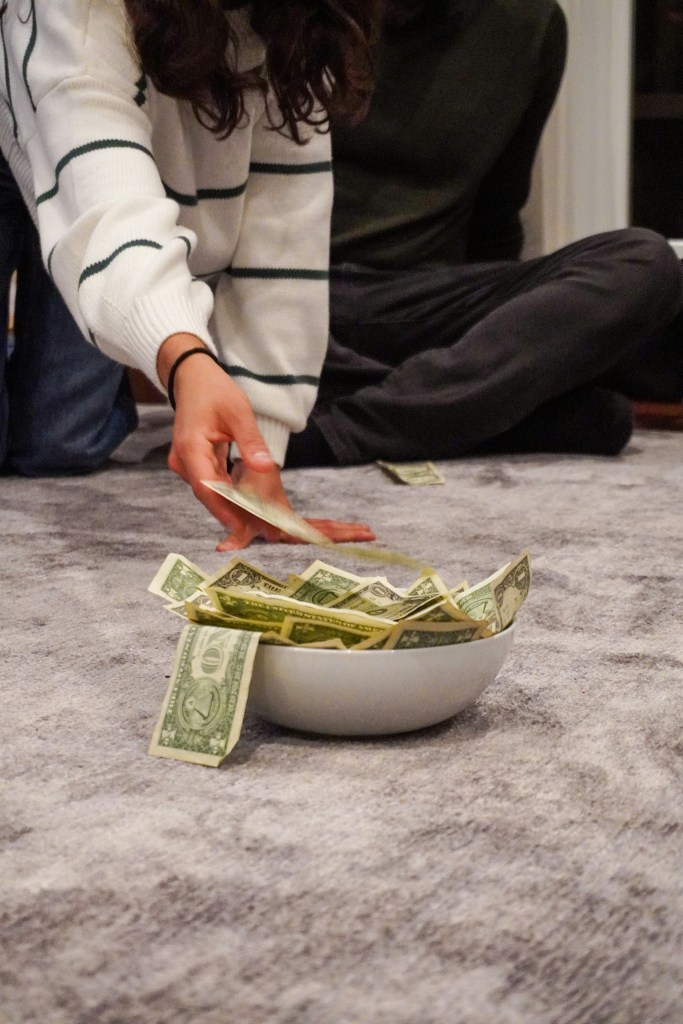
One of the first times I heard Crete’s chorus was during that first week of living together. After a day of panhandling, Crete came home with a heavy dose of grumbling. “People always treatin’ me like a trash can…they don’t know who I am…ain’t no love around here…” While his mouth expressed the frustration of being ignored and overlooked the last many hours, his hands were reaching into his pockets. He cleared it all out – every penny – and tossed it all into our small bowl by the front door: “take some, leave some.” I’d guess there were seven or eight dollar bills and a handful of coins. Crete’s open-handedness wasn’t impacted by the sparse earnings of the day or the callousness of so many that walked right by him without a glance. He gave it all. Like the widow’s gift in the gospels, it was an unrestrained offering – everything is God’s, after all. My own clenched-fistedness in stark relief, I examined the sparse spare change I had tossed in the bowl.
A personalist
is a go-giver,
not a go-getter.
He tries to give what he has,
and does not
try to get
what the other fellow has.
He tries to be good
by doing good
to the other fellow.
He is also altro-centered,
not self-centered.
He has a social doctrine
of the common good.
-Peter Maurin, in his Easy Essays.
Friendship with Crete has shown me a glimpse of the underbelly of our culture of acquisition and excess, bringing me face to face with the effects of what Pope Francis calls throwaway culture in Laudato Si – the logic that everything can be discarded, we can always procure something better, and some lives matter more than others. The poor (which includes our common home – the Earth) disproportionately suffer from this throwaway culture that “quickly reduces things to rubbish.” Any embodied alternative economics has to reckon with this pervasive logic and give witness to a renewed vision of care, encounter, and communion.
Crete’s radical witness has provoked our family to live an alternative economics rooted in the gospel, meager as our ordinary, small steps are. Lifted from our family’s financial rule of life, here are a few of our guiding principles:
- Everything is God’s…and there’s plenty for all
We want our way with money to be a servant of our communion with God and with all creation. Whatever we have is ultimately for the common good, of which our family is a part and within which the vulnerable/poor/peripherized are at the center. We yearn for whatever we count as ‘our possessions’ to facilitate self-donation and generosity rather than self-protection and control.
- Simplify so we can share
We seek to grow in a sparing-sharing lifestyle that involves consistent examination of why we have what we have and what is enough for us in this particular season. This involves at least modest renunciations across the board in regards to consumption, possessions, savings, investments, etc, and this is always connected to our pursuit of justice in love of neighbor.
- Interdependence and community
We strive for a way of life that bakes in reliance on others…we yearn to participate in the kinds of friendships that make intelligible a sparing-sharing lifestyle for the long haul…having, sharing, and bearing needs in a way that maintains a mutual flow of generosity with our neighbors (and perhaps some strangers). The community we cultivate makes possible the way of life we are called to embody. We’d rather ask someone for something that seems shareable than acquire something that’s convenient and expedient (and used thrice a year).
“If the question be asked: How must one’s possessions be used? – the Church replies without hesitation in the words of [St. Thomas Aquinas]: ‘Man should not consider his material possessions as his own, but as common to all, so as to share them without hesitation when others are in need.’”
Pope John Paul II in Centesimus Annus
This past weekend I recognized Crete’s imprint on our community life with lots of gratitude. Our family of five recently moved from this community house inspired by the witness of L’Arche and the Catholic Worker movement. We now live a few doors down in a neighborhood of 16 homes committed to a life together centered around persons with disabilities where everyone can experience the reality of our belonging in Jesus.
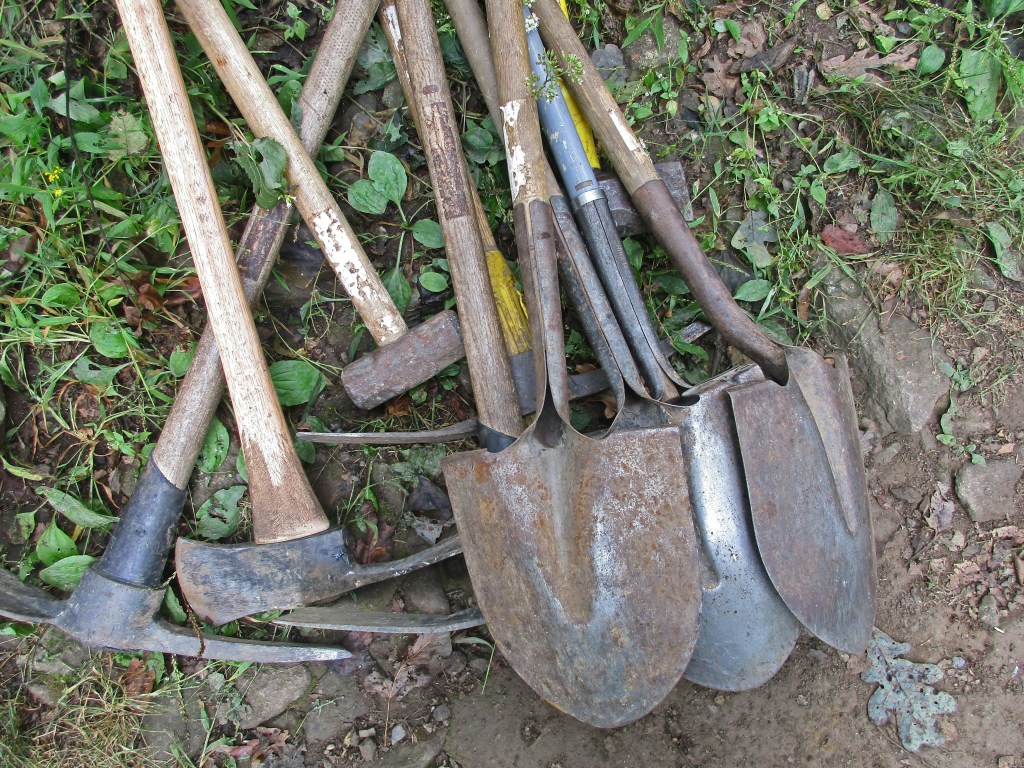
Because of our recent move, we have the arduous privilege of cultivating a new plot of land into a garden. These grass roots have had plenty of years to make their home in what will soon become our own fertile crescent for veggies, fruits, herbs, and flowers. Saturday was filled with several hours of labor to make this happen. It turns out that our task was bolstered – or, maybe put better, made possible by – the open-handed gratuitous sharing of our neighbors. All of our tools were not ‘ours’ – a pick-ax and kids’ shovel from some across-the-street buds…a rake, wheelbarrow and grown-up shovel from our next door neighbors…yards and toys from houses next door for our three kids to mess around for the hours of the day that unfolded…fresh compost from some other neighbors to add to our clay-laden spot…and if we were to dig even deeper, the logs we used to line the garden bed (and to set the atmosphere by building a fire) – the result of 1) former neighbors who offered their fallen tree, and 2) current neighbors who aided in laboring to chop down that tree into firewood. We even received the delightful gift of three blueberry bushes from some friends (and borrowed a buddy’s truck to pick them up). The whole Saturday was an alternative economics of sharing…of neighborliness…of shared goods for a common good. My 6-year-old son concluded this whole endeavor by insisting that we add a raised bed beside our planned plot, “for the whole neighborhood to plant some seeds and take some flowers.” Take some, leave some. Crete would certainly approve.
*To learn more about Crete and this particular hospitality house, read Colin Miller’s We are Only Saved Together.
Read more by this author and about living simply at our web site.
ABOUT THE AUTHOR
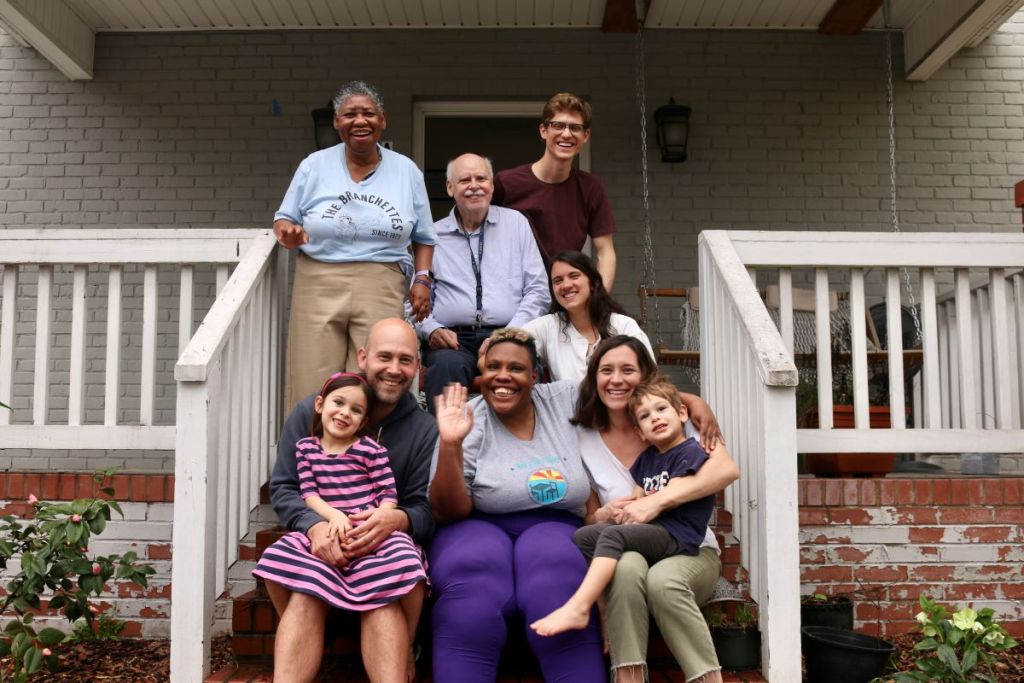
Greg Little is a husband to Janice and father to JoyAna and Elias and Terese (Resa), and he has a home at Corner House in Durham, North Carolina. He has learned from various schools, including several Christian communities seeking justice and peace (a Catholic Worker home inspired by St. Francis, Durham’s Friendship House and Haiti’s Wings of Hope) and is committed to a life ordered by daily communal prayer and littleness. He works at Reality Ministries, a place proclaiming that we all belong to God in Jesus through fostering friendship among people with and without developmental disabilities. Greg and Sister Julia recently met in the wonder of interfaith dialogue about monasticism and the contemplative life at Mepkin Abbey in Moncks Corner, South Carolina.