
Courageous countercultural choices inspired by St. Francis
This weekend, throughout the world, Franciscans will gather to celebrate the feast of our founder, St. Francis of Assisi. On Friday evening we’ll pray in holy spaces and remember his Transitus, his holy death. On Saturday we’ll gather for Holy Mass and celebrate his whole life, and the influence that he has had and continues to have on each of our journeys, on the global Church, and on Christians everywhere.

Over the years around St. Francis’ Feast Day I have written about the influence of St. Francis of Assisi and Franciscan values. Here’s an incomplete list:
- “We are an endangered species but Franciscan values could save us” (National Catholic Reporter / Global Sisters Report, October 2019)
- “Christian Resistance in the Style of St. Francis” (Messy Jesus Business, October 2018)
- “God make us poor and nonviolent like St. Francis” (Messy Jesus Business, October 2016)
- “St. Francis Day Photos” (Messy Jesus Business, October 2015)
With the arrival of another Feast Day of St. Francis, I find myself wondering how he has impacted me recently, how he is impacting all of us. I am recalling my pilgrimage to Assisi earlier this year. For the second time in my life, I visited the hometown of the founders of the Franciscan movement. I prayed at the tombs of Sts. Francis and Clare, visited their former dwellings, walked over the stone streets and passageways, and found healing and encouragement on the holy ground.
When I touched the walls of the Portiuncula, the tiny chapel where St. Francis and the early friars prayed and shared daily life, my whole body responded. A warmness flooded me, my face began to tremor, my breathing shifted, tears poured from my eyes. I sat on the cold floor and sobbed, then prayed and wrote in my journal. Only when I began to wonder what was causing such emotion to burst out of me did my body shift back to its normal state.
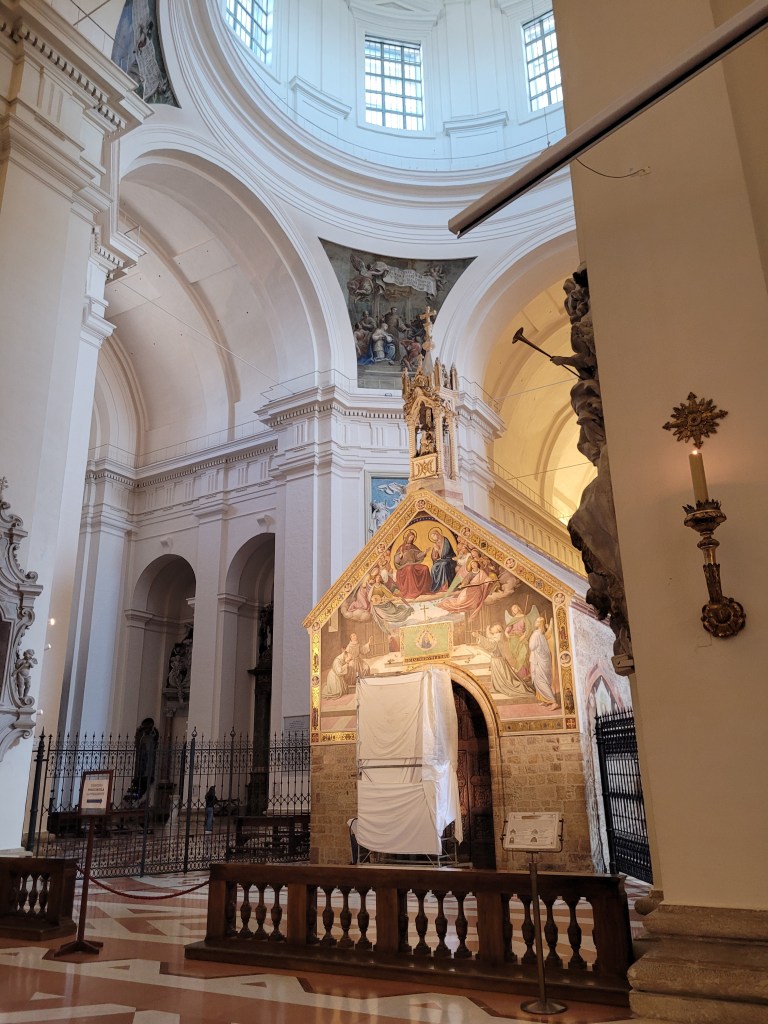
Weeks later, I sat with my spiritual director and told him about the emotional reaction I had to the Portiuncula, still puzzled by the experience. In his gentle and astute way, he asked me about the meaning of the Portiuncula, which is now housed inside a giant Basilica. I told him how the early friars lived in huts surrounding the Portiuncula and the tiny church was the center of their fraternity. During that time, it was in the swamp, outside the security of the Assisi walls. The early Franciscan community was simple, small, and lovingly present to those whom the village of Assisi didn’t care for, who they despised and considered dead: lepers.
The fraternity lived in solidarity with those who were outcast and rejected, and this courageous and countercultural way of life changed the Church, the world. It was the foundation, the heart of the Franciscan movement. As I explained all this to my spiritual director, I began to weep again, and once again wondered why. After more conversation, my spiritual director and I guessed that the sacredness of the Portiuncula touched my own heart, pulled at the heart of who I truly am and what I desire for the Franciscan movement.
799 years since the death of St. Francis, in the wealthy and complicated United States of America, it is easy to distance oneself from the poor. It is easy to avoid discomfort as a coping method. Yet our current circumstances reveal that now is time for a revival of courageous and countercultural choices. We need to surrender our privilege and power, to take risks and gently insist that the poor and marginalized are respected, protected. We need to share daily life with the little ones, the small and rejected, and as we do we’ll humiliate ourselves, relinquishing more power and privilege, becoming more marginalized ourselves. This is a holy path, a way of surrender and peacemaking that reveals the goodness of all people and creation.
In this time, little by little and by God’s grace, when our own small Christian communities boldly love those on the margins and become poor ourselves, we shall show the world the radical messiness of Gospel living. This is the Franciscan path, one way that St. Francis continues to change the world. Thanks be to God.