Solidarity is a Way of Making History
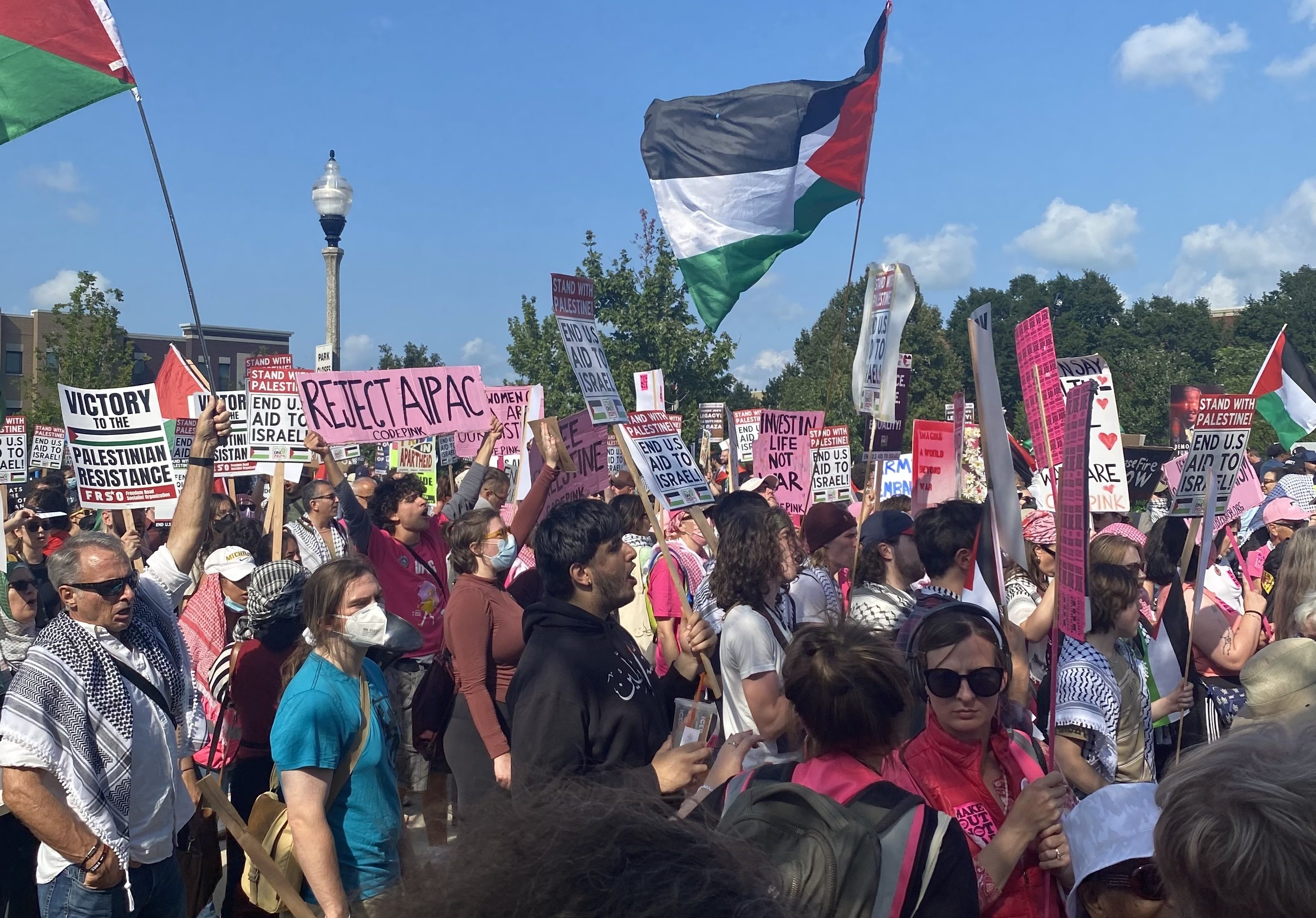
There was electricity. A sensation palpable in the air, yet powerfully felt in the spirit. The sounds of feet marching and people shuffling together, the sight of posters and larger-than-life puppets hand drawn and handmade, and voices chanting in unison. Only a solidarity across race, class, gender, and faith this deep for global liberation can produce this type of electricity. Despite the long hours under the sun and massive crowds, it was a clear example of what the kin-dom of God looks like – when the diversity of God’s people come together against injustice, as Jesus’ kingdom movement did.
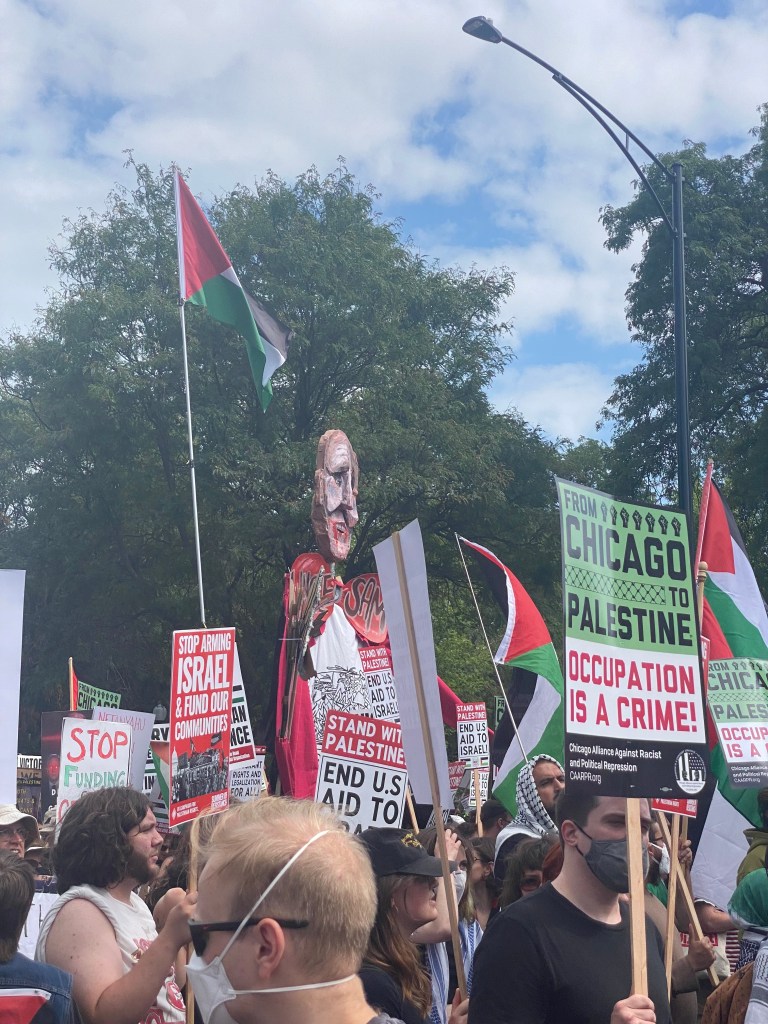
A number of friends and I marched alongside 20,000 persons on August 19th, the first day of the Democratic National Convention, to demand an end to the genocide in Palestine. Marching that day was a small act of solidarity for me. Pope Francis’ encyclical on fraternity and social friendship, Fratelli Tutti, outlines how solidarity, at its essence, is about “thinking and acting in terms of community.” This community extends well beyond our neighbors, family, and close friends. My fundamental belief as a Catholic and Christian is that everyone, locally and globally, is our sibling in Christ. We are deeply and divinely interconnected.
Pope Francis also shares that solidarity is a way of making history. We can draw from historical examples of solidarity that helped advance liberation for the people of God like Solidarnosc in Poland, the Civil Rights Movements, and the United Farm Workers that drew in thousands of collaborators and allies to help win workers and human rights on a grand scale.
We are faced with another critical moment for liberation in our present day that demands our solidarity. For the past ten months, we have witnessed a war that has been enacted on innocent civilians. Tens of thousands have been killed or gone missing, with their lands, schools, religious institutions, and hospitals completely demolished by bombs funded with U.S. taxpayer dollars.
The U.S. government has sent well over $12.5 billion to Israel for this devastating war. Imagine if our taxpayer dollars were funneled into life-giving initiatives rather than those geared towards death and destruction. We could imagine our neighborhoods with well-funded public schools, affordable childcare for working families, community centers, programs for restorative justice, and so much more. Yet, our communities are left disinvested with minimal resources, which exacerbates existing cycles of poverty, trauma, and violence. Our government pours our money into a war that creates unimaginable pain and terror, while our local communities suffer in crushing ways.
Because of this connection, we understand that this is not only an international issue of solidarity, but a hyperlocal one as well.
Solidarity is an invitation to act. When we remain passive or silent on issues of extreme injustice, our hearts and spirits remain closed, unable to exercise empathy or compassion. At times, the silence and passivity can leave an unshakeable imprint of guilt and remorse.
One parishioner at Our Lady of Africa Parish, located in the southside of Chicago, who we have the great honor of working alongside, shared stories of her experience growing up in Germany. At a young age, she was taught about the Holocaust and was shaken to her core. She asked her teachers, “Well, what did you do? Did you help the Jewish people?” Her teachers’ responses included, “I wish we would have done more…Some of us didn’t know what was going on…” She responded, “But you saw their businesses blown up, you saw them carried away like chattel, it was impossible for you not to know what was happening!” The teachers just stayed silent, the weight of guilt and remorse etched on their faces.
The same parishioner told me about her travels to Palestine and Israel many years ago. The first time she went, she said she went to bed crying every night from witnessing the mistreatment and oppression of the Palestinian people. She shared that a common saying there is, “Even the rocks cry out,” at the inhumane conditions endured daily by the indigenous peoples of Palestine. She and her parish are now organizing a prayer vigil for peace in the Middle East to encourage Catholics to pray and act on this issue.
As followers of Jesus, who grew up in first-century Palestine and was vehemently opposed to the Roman imperial occupation of his fellow Jewish people, we must let our faith serve as our moral and spiritual compass in this critical moment. We must let our solidarity deepen and stretch our hearts to love more deeply and to act more courageously for justice.
Let the words of Fratelli Tutti sink deep into our hearts to rattle and agitate you – “Solidarity is a way of making history.” Are you willing to make history? Are you willing to act?
Resources:
- Franciscan Action Network – a collective Franciscan voice seeking to transform United States public policy related to peacemaking, care for creation, poverty, and human rights.
- Friends of Sabeel North America, an ecumenical liberation theology movement founded by Palestinian Christians in the Holy Land
- Muslims for Just Futures, a grassroots organization that builds power in Muslim communities through collective care, organizing, advocacy, and movement-building.
- Jewish Voice for Peace, Jewish Voice for Peace is the largest progressive Jewish anti-Zionist organization in the world.
ABOUT THE AUTHOR
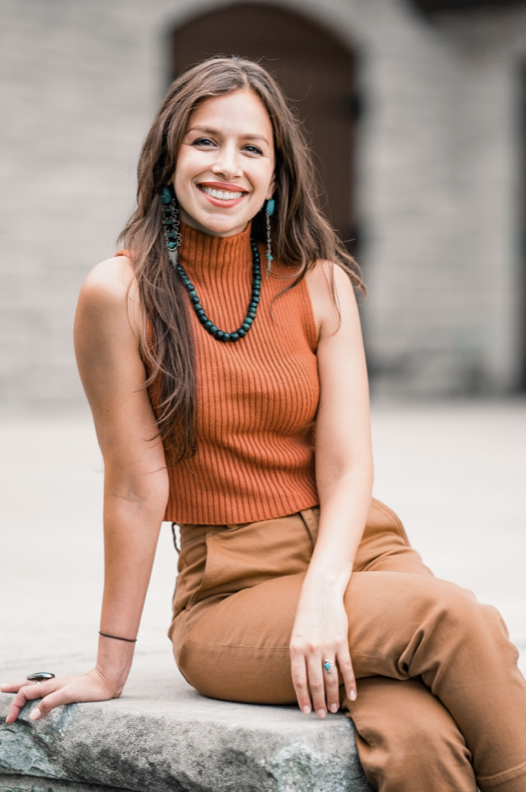
Joanna Arellano-Gonzalez is a first-generation Mexicana-American, born and raised in La Villita, Chicago, a neighborhood known as Mexico of the Midwest. She is the Director of Training and Spiritual & Theological Formation at CSPL. In addition to being a co-founder and founding board member of the Coalition for Spiritual & Public Leadership, she was a founding board member and Board President of The Co-Op Ed Center, a worker cooperative incubator dedicated to helping build cooperatives with communities of color in Chicago.
She formerly worked at the Archdiocese of Chicago in the Office for Peace & Justice, and later in the labor movement for five years leading communications and press strategy at a local and national level.
Joanna received her Masters in Christian Spirituality at Fordham University, with a concentration in Spiritual Direction. She works to center mujerista/womanist, queer, indigenous, and liberation theologies and spiritualities. As an artist, Joanna centers her embroidery and beading practice around honoring her culture, familia, and spirituality.


One Comment